(As published in The Recorder – The Journal of the Ontario Music Educators’ Association, Volume 60, Number 1, Autumn 2017)
Making Connections… How Music and Mathematics Can Come Together in Harmony
By Mishaal Surti, M. Ed.
If any educator was asked about the current topic of conversation during professional learning, staff meetings, and other forms of professional dialogue in their schools and districts it would not take long to hear the ‘other’ m-word… math. At a time when educators throughout the province are focused on supporting student, parent, and educator understanding of mathematics through a Renewed Math Strategy for Ontario, it can feel difficult to find our voices as music educators. Where do we fit into the grand scheme of School and Board Improvement Plans for Student Achievement that may be focused on numeracy and mathematics development? More importantly, how can we leverage the vital learning opportunities that music creation and performance offer our students as part of a school or board community when much of the focus can seem to be elsewhere?
One idea is to reconsider the differences between the teaching and learning of music and mathematics, and instead embrace how similar these classroom experiences can be. Rather than ‘fitting’ into someone else’s school goal or mould of professional learning, perhaps a first step is to consider how aligned our pedagogical practices are and starting to explore how to ‘talk the same talk’.
Talking the Same Talk
It can be common for a teacher to be asked by a leader, “how are you embedding numeracy in your classroom?” Without knowing the current vernacular of mathematics pedagogy, it can be hard to answer this question in a way that translates the work we are doing in our music classrooms on a daily basis. However, by reframing the terminology that we use – both with students as well as colleagues – it can be easily apparent how many of the mathematical processes we integrate in our classroom on a daily basis. The Ontario math curriculum is guided by seven math process expectations:
- Problem solving
- Reasoning and proving
- Reflecting
- Selecting tools and computational strategies
- Connecting
- Representing
- Communicating
In considering the deeper definitions of these ideas in the mathematics curriculum documents, it is apparent that these thinking processes ideas relate to the arts, science, literacy, and any other subject just as much as they do to mathematics. Moreover, many of these processes are one in the same to the components of the creative process, but under a different name.
To help align our work in the music classroom with our colleagues focusing on these processes in a mathematics classroom, one overarching strategy can be to create a similar talk community in the classroom where we focus on student thinking and reasoning through the questions we ask as educators.
What Do You Notice? What Do You Wonder?
A common idea embedded in many mathematics classrooms is providing students with an image or problem, and asking them to consider “what do you notice?”. After sharing these noticings (or observations), students then move to considering “what do you wonder?” (or inquiry questions). This simple phrase can easily be translated into a music classroom:
- When working through a listening example in the class, ask students “what do you notice?” and scribe these ideas on a sticky note, whiteboard, etc… Some responses could be “it is major”, or “I hear a saxophone as part of the accompaniment”. A follow up conversation would then be brainstorming their wonderings. Some possible prompts to the question “what do you wonder?” could include “I wonder how many instruments are in the accompaniment?” or “I wonder if we can write out the chart to perform it?”. These questions can then lead to a larger scale inquiry task.
- Before beginning a sight-reading passage, ask each pair of students to come up with 2 noticings and 1 wondering about the music. Sharing these noticings and wonderings as a class can lead to a conversation around key signatures, time signatures, instrument range, dynamics, and more.
- A slight modification to the idea above is to only provide students with the first 3 measures of a phrase. Wonderings could be extended to explore composition by considering what the 4th bar could be and then comparing the composed ‘final bar’ between groups.
Problem Solving and Inquiry… Where Can We Start?
As many schools focus on a problem solving and inquiry approach to mathematics, the connections to the music classroom may seem blurry. One approach to consider is a focus on the mathematical process expectations of reasoning and proving, reflecting, and communicating.
One strategy or prompt being used throughout the math circles is called Which One Doesn’t Belong (www.wodb.ca). Students are provided with 4 images/numbers/shapes/etc and are asked to choose and defend the one image that ‘definitely doesn’t belong’. This strategy can easily be translated into the music classroom such as with the examples below where classroom discussions can lead to conversation around key signatures, rhythms, compound time, modality, and more:
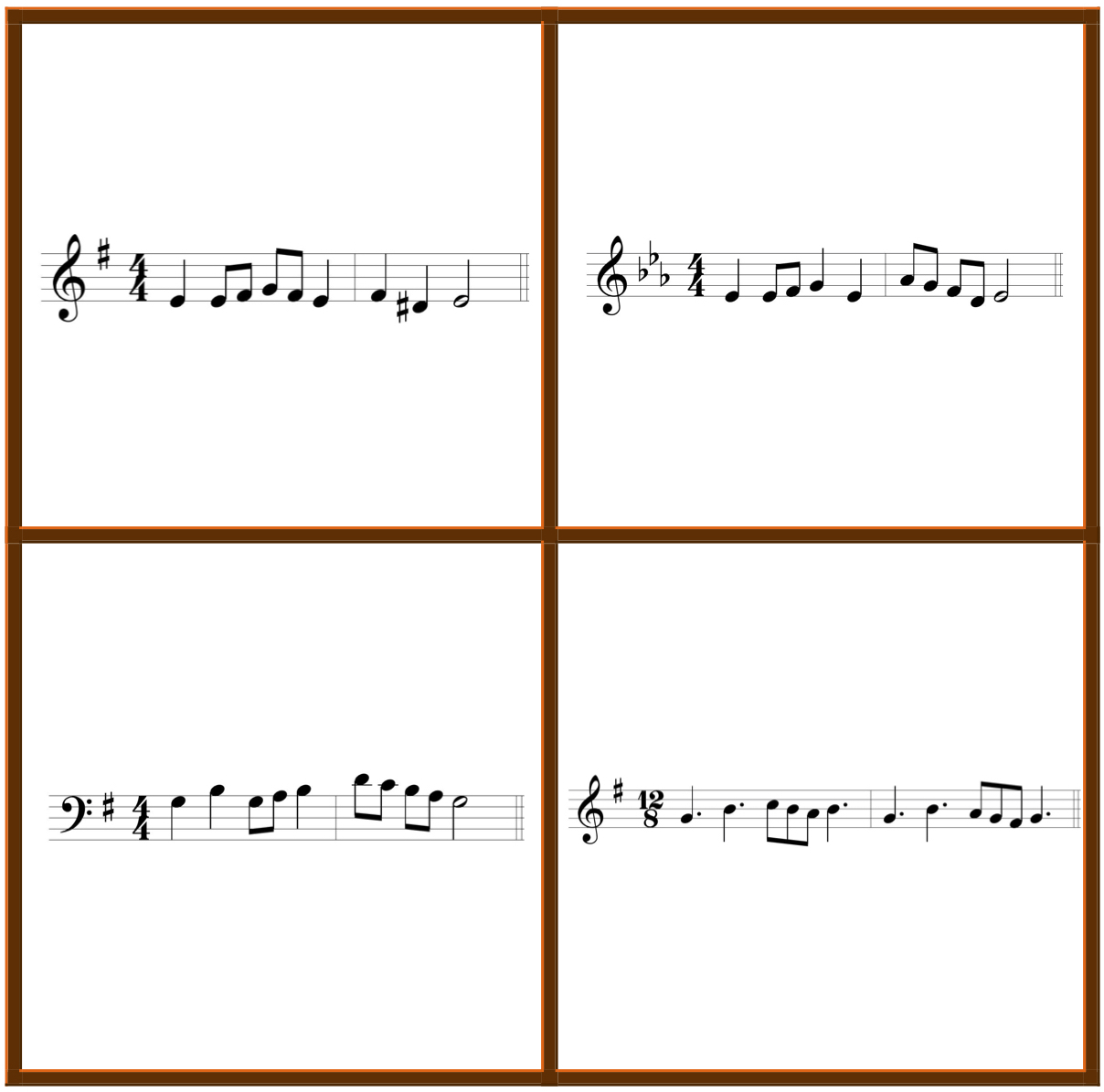
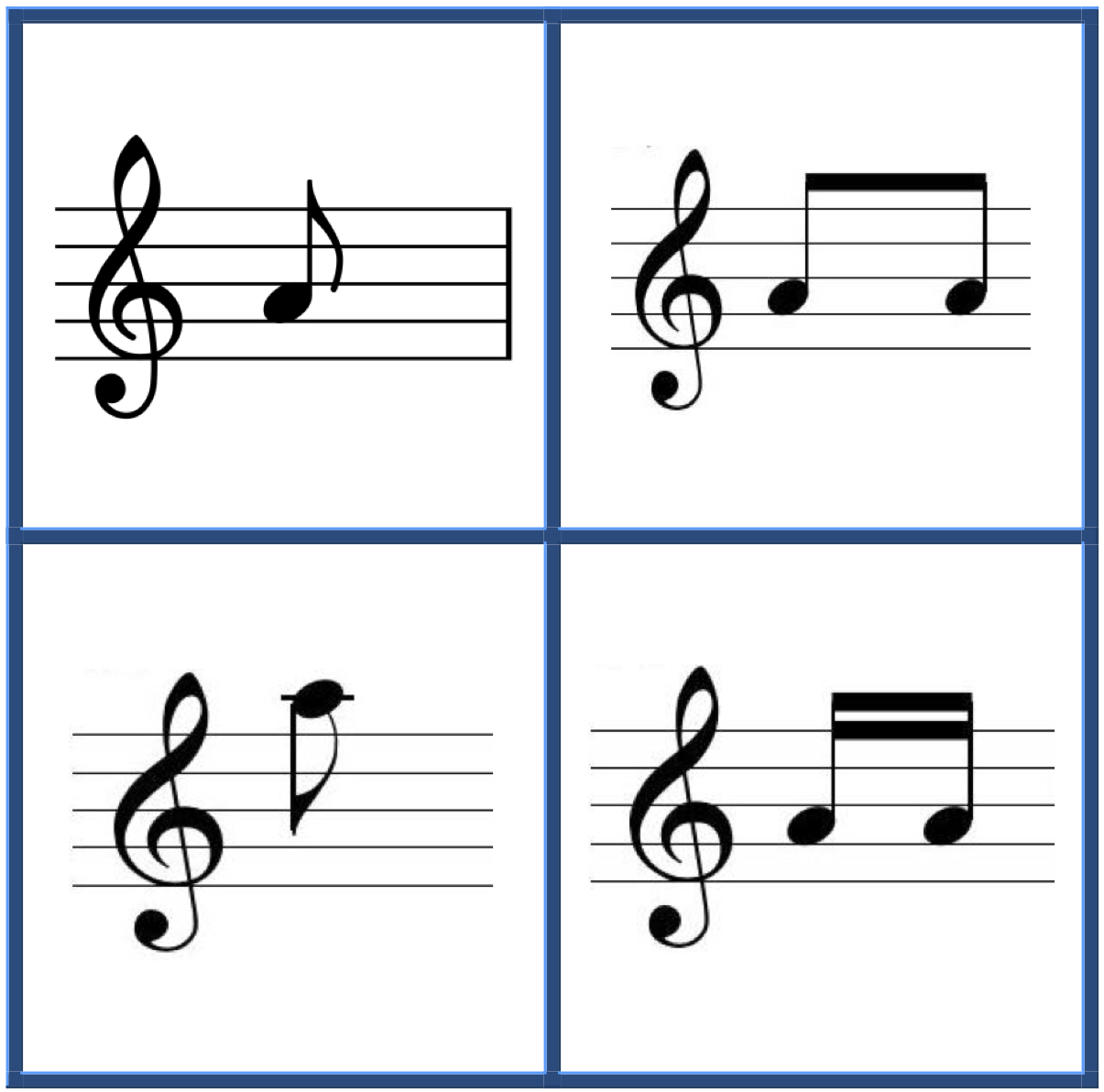
From Number Talks to Music Talks
Dr. Chris Suurtamm and Dr. Marian Small both speak of the importance of asking rich questions that develop student understanding. These ideas go hand-in-hand with a strategy being explored throughout the province called Number Talks where students discuss an open question that encourages multiple strategies. By being intentional to reframe our questions to encourage multiple entry points and invite multiple approaches and strategies, students are able to focus on reasoning and “thinking mathematically” (Suurtamm, p. 3). Some examples of these open questions that can inspire a Music Talk or classroom discussion include:
- A rhythm in ¾ time has 5 notes. What could the rhythm be?
- A 1 bar rhythm has a half note and 2 other notes. What could the time signature be? What is a time signature it definitely cannot be?
- How could these notes be beamed to make 1 bar of music in 6/8? 2/4? | | | | |
- What could a rhythm look like that is definitely in 2/2?
- The answer to a question is Bb and Eb. What could the question be? (Ex. Name two notes that are a perfect fourth apart)
- Which two of the notes below are the most alike? Which are the least alike?

Where Do We Go from Here?
While discussions around these prompts can lead to deeper understanding of rhythm, notation, melody, key signatures, form, and other elements of music in our classrooms, perhaps more importantly, integrating these ideas and processes help connect what we are doing in our classrooms to those of our colleagues. Through the use of these common structures and ideas, perhaps we are better able to see where we ‘fit’ in a school’s professional learning plans. Moreover, by focusing on the integration of these thinking and reasoning processes, developing a classroom talk community, and leveraging questioning in our classrooms, we can help develop musical understanding and artistry at a much greater depth than any theory worksheet could do. Instead of being forced to put rhythms on a number line on a daily basis, it is time to come together as a school team of colleagues working towards a common goal of developing student understanding and reasoning through an inquiry lens.
References
- National Council of Teachers of Mathematics. (2014). Principles to actions: Ensuring mathematical success for all. Reston, VA: Author.
- Ontario Ministry of Education. (2009). The Ontario curriculum grades 9 and 10: Arts. Retrieved from http://www.edu.gov.on.ca/eng/curriculum/elementary/arts18b09curr.pdf
- Ontario Ministry of Education. (2005). The Ontario curriculum grades 9 and 10: Mathematics. Retrieved from http://www.edu.gov.on.ca/eng/curriculum/secondary/math910curr.pdf
- Small, M. (2012). Good questions: great ways to differentiate mathematics instruction. Toronto, On: Nelson Education.
- Smith, M. S., & Stein, M. K. (2011). Five Practices for orchestrating productive mathematics discussions. Reston, VA.
- Suurtamm, C., Quiqley, B., & Lazarus, J. (2015). Making space for students to think mathematically. What Works? Research into Practice. Toronto: Ontario Ministry of Education.


 Mishaal Surti
Leave a comment